Esteve • supplied in India by Akira Analytical Solutions Pvt. Ltd.
Ion Pair Reagents
Ion Pair Reagents are mobile-phase additives that form neutral or retained ion pairs with acidic or basic analytes to improve reversed-phase HPLC retention and selectivity.
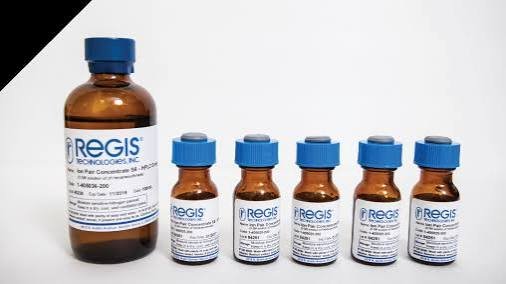
What are Ion Pair Reagents?
Ion Pair Reagents are mobile-phase additives that form neutral or retained ion pairs with acidic or basic analytes to improve reversed-phase HPLC retention and selectivity.
Counter-ion chain length, pH, organic solvent percentage and concentration control retention. These reagents are used for pharmaceutical analysis, biomolecule separations, acidic/basic analyte methods, gradient optimization and troubleshooting.
Technology, mechanism and applications
Counter-ion chain length, pH, organic solvent percentage and concentration control retention. These reagents are used for pharmaceutical analysis, biomolecule separations, acidic/basic analyte methods, gradient optimization and troubleshooting.
- Method development and replacement screening support
- Pharmaceutical QC, impurity profiling and research laboratories
- Typical analytes include APIs, intermediates, ionic compounds, racemates and polar analytes depending on family
- Storage and care: use compatible solvents, filter mobile phases and follow validated laboratory procedures.
Technical support
For product selection, dimensions and method transfer support, contact Akira Analytical Solutions Pvt. Ltd..
Available catalog specifications
| Product name | Chemistry | Particle size | Dimension | Catalog number |
|---|---|---|---|---|
| 1-PENTANESULFONATE (25 g) | PENTANESULFONATE | N/A | N/A | 1-403025-200 |
| 1-HEPTANESULFONATE (25 g) | HEPTANESUFONATE | N/A | N/A | 1-403027-200 |
| 1-OCTANESULFONATE (25 g) | OCTANESUFONATE | N/A | N/A | 1-403028-200 |
| 1-PENTANESULFONATE (100 g) | PENTANESULFONATE | N/A | N/A | 1-403125-200 |
| 1-HEPTANESULFONATE (100 g) | HEPTANESUFONATE | N/A | N/A | 1-403127-200 |
| 1-OCTANESULFONATE (100 g) | OCTANESUFONATE | N/A | N/A | 1-403128-200 |
| 1-PENTANESULFONATE (1000 g) | PENTANESULFONATE | N/A | N/A | 1-403325-200 |
| 1-HEPTANESULFONATE (1000 g) | HEPTANESUFONATE | N/A | N/A | 1-403327-200 |
| 1-OCTANESULFONATE (1000 g) | OCTANESUFONATE | N/A | N/A | 1-403328-200 |
| ION PAIR CONCENTRATE Q6 (100 mL) | ION PAIR CONCENTRATE Q6 | N/A | N/A | 1-404036-200 |
| ION PAIR CONCENTRATE Q8 (100 mL) | ION PAIR CONCENTRATE Q8 | N/A | N/A | 1-404038-200 |
| Tetrabutyl Ammonium Phosphate 0.5 M (pH=7.5) (500 mL) | TBAP | N/A | N/A | 1-680503-200 |
| Tetrabutyl Ammonium Phosphate 0.5 M (pH=7.5) (1 LT) | TBAP | N/A | N/A | 1-680504-200 |
| Tetrabutyl Ammonium Phosphate 0.5 M (pH=7.5) (50 mL) | TBAP | N/A | N/A | 1-680505-200 |
Frequently asked questions
How do ion-pair reagents increase retention?
They form ion pairs with charged analytes, increasing hydrophobic interaction with the reversed-phase surface.
Which analytes benefit from ion-pair HPLC?
Strongly acidic, strongly basic and highly polar ionic compounds often benefit.
Can ion-pair reagents be used with LC-MS?
They require caution because some reagents suppress ionization or contaminate MS systems; volatile alternatives may be preferred.
What causes poor reproducibility?
Uncontrolled pH, insufficient equilibration, variable reagent concentration or contaminated systems can affect retention.
Who supplies ion-pair reagents in India?
Akira Analytical Solutions Pvt. Ltd. supplies ion-pair reagent products in India.